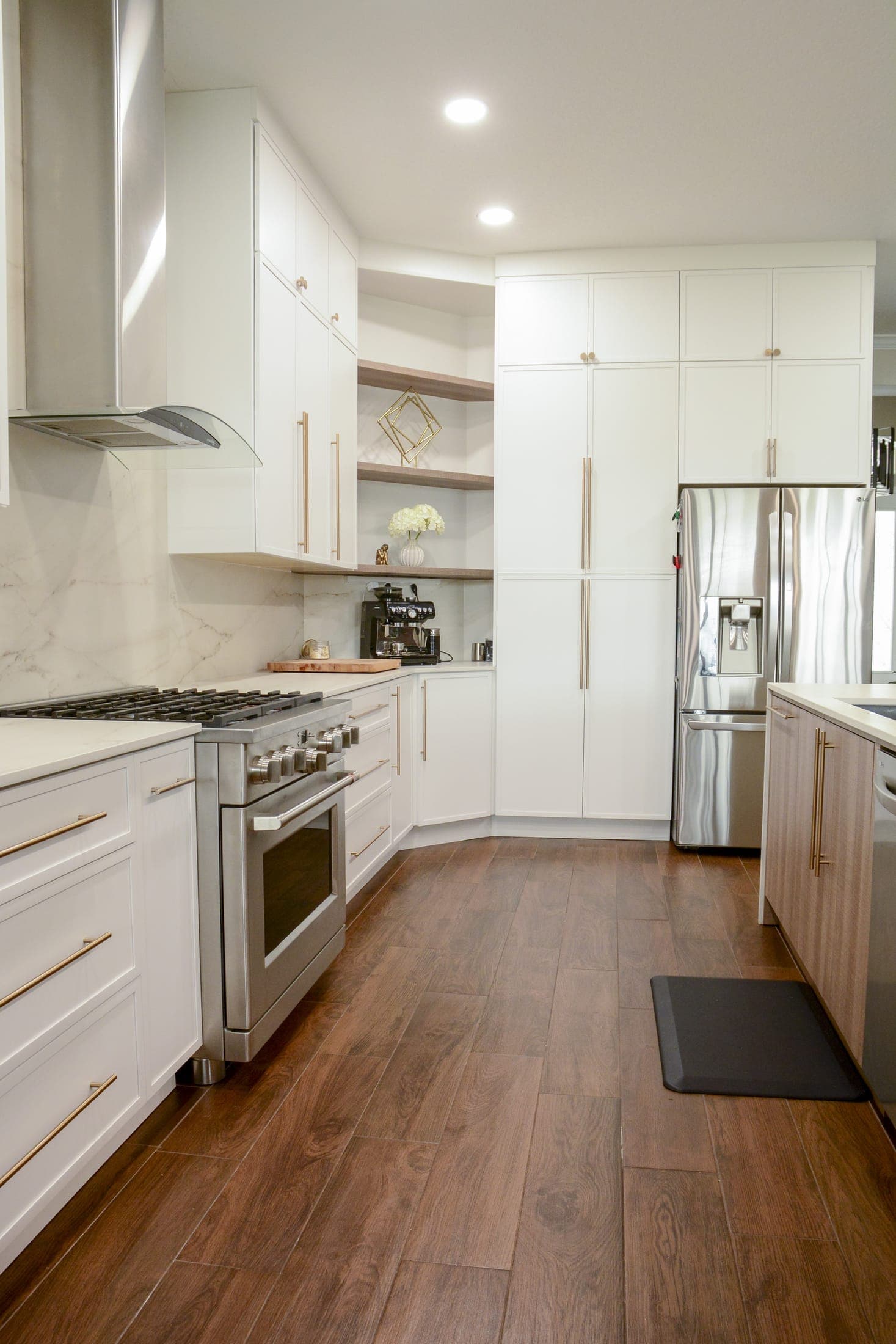
The number the design desk prints for you at a big store isn't the price of your kitchen. It's the price of boxes and doors. Countertops are a separate ticket. Demolition, another. The plumber who moves your sink eighteen inches is yours to find. None of that is a trick, it's how the model works: it's why two bids for the identical room land thousands apart and both are honest.
We've already compared the products themselves in custom versus stock cabinets. This is the other half of the decision: two different businesses, and what changes for you on the Tuesday morning when something doesn't fit.
Make both quotes describe the same room
Before you compare a dollar, give both bidders the same scope and make them price it line by line. Most of the gap you're staring at is scope, not craftsmanship.
| Line item | Big-box package | Local custom shop |
|---|---|---|
| Boxes and doors | Included | Included |
| Fillers, end panels, toe kick, crown | Often itemized later | Usually built into the run |
| Final measuring visit | Usually subcontracted, sometimes a fee, ask | Done by whoever builds it |
| Demolition and haul-away | Usually separate, and usually a separate crew | Usually inside the number — make it a line you can read |
| Countertops, plumbing, permits | Usually yours to coordinate, ask | Usually scheduled by the shop, billed by each trade |
Same list, priced twice: that you can compare. Two different lists tell you nothing.
Whoever measures owns the mistake
In the big-store model, the person who measures is usually a subcontractor paid per visit. He measures what's in front of him, writes it down and leaves. He didn't draw the layout, he won't build the cabinets, and he isn't there on install day.
That's fine in a 2012 house in Lake Nona where the walls are square and the drywall sits where the plan said it would. It's another story in a 1950s block house in Winter Park, where the plaster wanders enough over a few feet that no corner is truly ninety degrees. Stock runs swallow that error in fillers — the strips an installer slips between the cabinet and the wall. A few fillers later you've given away inches of cabinet, the sink base no longer centers under the window, and you find out when it's already screwed to the wall.
The other classic: somebody measures the refrigerator opening before the drywall goes up. The finished wall eats the thickness of the drywall on each side, plus the mud over the corner bead, and almost nobody subtracts it. The fridge slides in. The door won't clear the cabinet beside it. Nobody notices until delivery day, and by then the cabinet is paid for.
The day something doesn't fit
A wrong or damaged door in a catalog line means a reorder: a form, an approval, and a wait that can stretch into weeks, because it comes from a factory that runs batches. While you wait, the countertop can't be templated, the backsplash can't go up, and the plumber you booked may have moved on to another job. A local shop usually solves the same problem out of its own material, in days rather than weeks.
What you can actually change
Most catalog lines step in three-inch jumps. Thirty, thirty-three, thirty-six. Your wall is ninety-four inches, so you get ninety inches of cabinet and four inches of filler, and someone will tell you that fillers are normal. They are, and they're also dead space at the exact end of the run where you wanted the broom closet.
Custom doesn't earn its money on the door style; shaker is shaker. It earns it in the inches and the insides. A pantry built at thirty-four and a half inches so the run finishes flush to the wall. A drawer stack instead of a door with a wire rack rattling behind it. Drawer boxes deep enough for the stock pot you actually own.
One finish detail worth more than a brochure: thermofoil doors are vinyl film heat-pressed onto MDF, and heat is what makes that film let go. The corner of the door beside a wall oven is where it shows first, which is why a heat shield, or a different door material in that one opening, is worth asking about.
Florida is hard on a cheap box
Particleboard and plywood look identical with the door closed on them. The first time a dishwasher supply line starts to drip, you find out which one you bought. Particleboard wicks the water, swells, and never comes back; the sink base floor falls apart like wet cardboard and the toe kick goes soft underfoot. Plywood gets wet, dries, and usually lives.
Then the slow version. A house shut up in August with the thermostat at 80 °F, or a week without power after a storm: indoor humidity sits high for days. On a painted MDF door that's where the hairline shows at the joint of the frame, a ridge you catch with a fingernail before you can see it, and no touch-up hides it. A cabinet spec that's fine in Phoenix isn't automatically fine here.
Who picks up the phone in 2028
Two years in, a drawer slide fails. With the store you call a number, it routes to a warranty desk, you go hunting for the receipt, and the installer who hung the cabinet was a subcontractor who may not work with them anymore. The written warranty can read generously. The problem is in who shows up.
With a local shop it's the same number and often the same person, and a sagging door is usually a short service call instead of a claim. The honest other side: small shops close. Ask how long they've been at that address, and who stands behind the work if they aren't around.
When the store is the right call
There are kitchens where the catalog is the right answer. If yours is one of them, the money you save belongs in the countertop or the floor, not in boxes nobody will open differently.
- A straight galley with standard appliance openings and square walls. Nothing to solve, and custom is paid problem-solving.
- Rentals, flips, or a house you're listing in six months, where the question is what a buyer actually pays you back for and not what you'll enjoy.
- Under roughly ten linear feet of cabinet, the inches custom wins back are too few to feel.
- Speed, when you need it: in-stock lines sit on a shelf, while a custom run only goes into production once the drawings are approved.
Custom pays for itself the moment the room fights back. A wall out of plumb. An appliance that isn't a standard size. An island that has to work around a structural column, or a kitchen where the island, the pantry wall and the built-ins have to read as one piece of work. At that point the catalog costs you more in compromises than custom costs in dollars — and if the job reaches past the kitchen into the laundry or a bathroom, whether those rooms get built in the same visit or years apart moves the number again.
Four questions that settle it
Ask both bidders in writing. Who takes the final measurements, and does it happen before or after drywall? How many days for a replacement part? Plywood or particleboard, and on which parts of the cabinet? And in two years, who do I call, and what does that person come out for?
The answers will sort your two bids faster than any spec sheet. If you want a second read on the bid you already have, or a written scope for both bidders, book the free consultation. Photograph the wall before you come.